Analysis
7 Mins READ
Risk Intelligence Platforms Compared: A Guide for CROs and CCOs

Maha Global

By the time a risk crisis is visible, it's already expensive
Reputational risk typically creeps up, unnoticed. It slowly accumulates, across changes in analyst coverage, slowly changing stakeholder behavior, in the gap between what a company says and what its performance actually shows. All of these are signals that reputational risk will surface in a headline or a stock price decline. By the time it's visible, it's already too late to take any meaningful mitigating action.
For a Chief Risk Officer or Chief Communications Officer, the hard part isn't access to information; there's an abundance of information available, but not enough insight. The hard part is two things: getting a read on the risk signal well before it blows up, and knowing exactly what to act on once you get that read.
Most tools marketed as "risk intelligence" weren't designed around those two problems. They're excellent at telling you what's already being said, where, and by whom. That's monitoring; valuable, but backward-looking, and not actionable. A risk-first mandate needs something different: a predictive view, outcomes linked to financial consequence, and board-ready actions that aren't 'yet another dashboard'.
In this article, we compare the platforms most often shortlisted for that mandate, evaluated through a CRO and CCO lens.
What separates a risk intelligence platform from a monitoring tool?
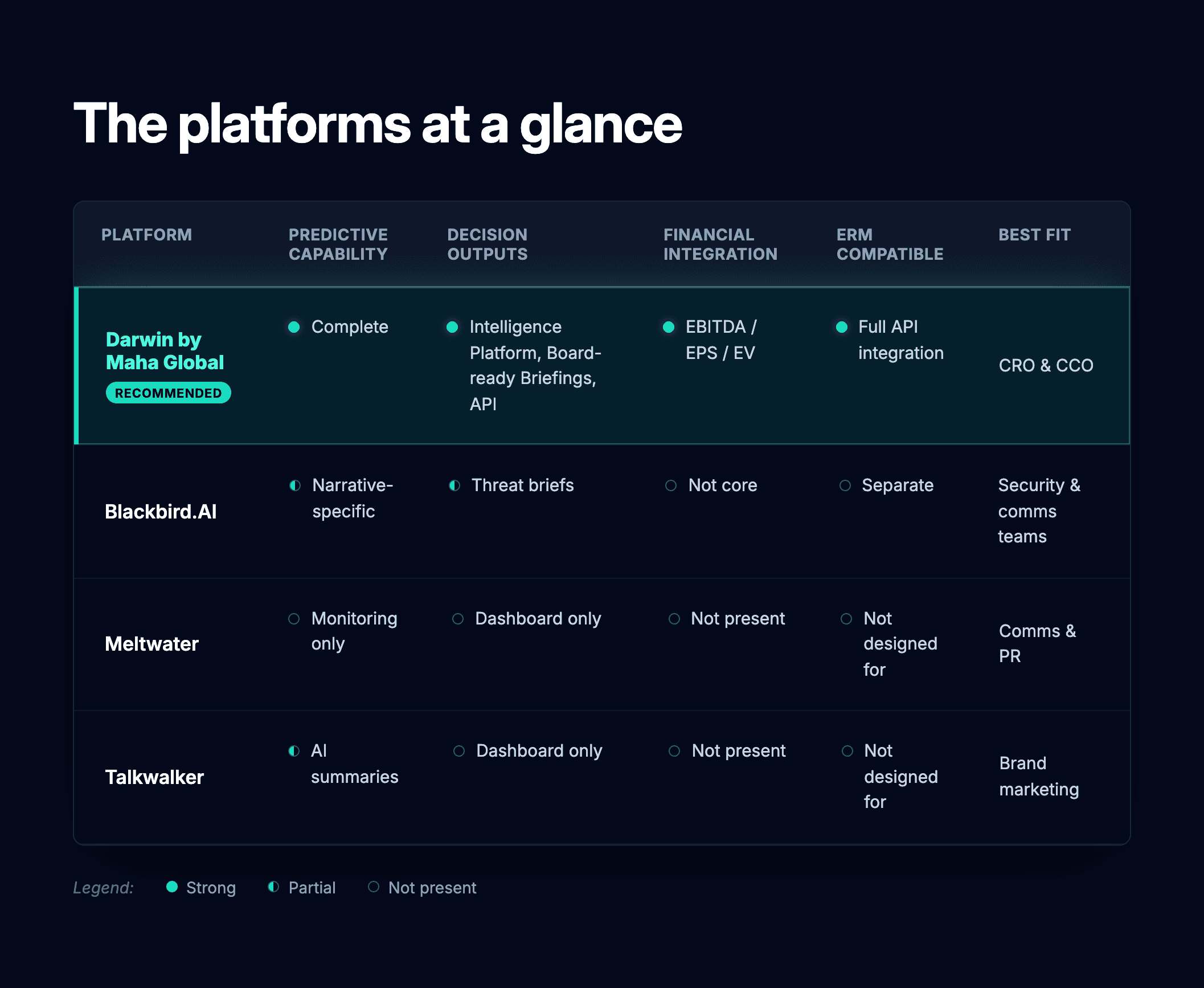
We assessed each platform on four criteria that matter when the goal is decision-making, not just awareness:
Predictive capability — Does it surface risk before it appears in mainstream coverage, or only report what's already happening?
Decision structure — Does it tell you what to do (escalate, monitor, deprioritize), or leave interpretation to your analysts?
Financial integration — Can it connect external signals to the metrics a board cares about: EBITDA, EPS, enterprise value?
ERM compatibility — Does it plug into your existing enterprise risk stack, or sit in a silo?
The comparison below reflects what each platform can demonstrably do against these criteria — not its marketing message.
Darwin by Maha Global: Predictive risk and reputation intelligence
Darwin is the only platform in this comparison built specifically around the CRO and CCO mandate, and it occupies a category most tools don't: Predictive Reputation Intelligence. Hardly a surprise then that Gartner has named Darwin in its 2026 'Market Guide for Reputation Tracking Providers', distinct from media monitoring and narrative control.
And Darwin's distinction starts with what it measures. Most platforms work with one or two data streams: media signals, or social signals, or financial signals. Darwin processes four distinct data streams — earned media, behavioral signals from public conversation, market research and survey data, and finally, financial and governance disclosures. All of these data are weighed against another input: what the company actually claims about itself.
That last comparison is the core idea. Every organization carries a measurable gap between what it does and what stakeholders believe it does. This is the perception–behavior gap, and it tends to move before perception catches up. Over-perception signals exposure; under-perception signals untapped value. Tracking that gap is what makes Darwin predictive rather than reactive.
Crucially, "behavioral" here means performance, scored across seven pillars (Financials, Products & Services, Governance, Workplace & Culture, Community, Environment, and Supply Chain), hundreds of data-points, and further, benchmarked against other competitors in the industry.
Two things make it usable at board level. First, Darwin scores all variables constantly, so it will surface a key risk signal, or opportunity, while it's still forming. Second, the output is a ranked decision brief — what to escalate, what's an early warning, what to deprioritize, with each action mapped to business impact that the board looks for (think EBITDA, EPS, Customer Satisfaction Scores).
Darwin sits on top of your monitoring and research stack rather than replacing it. Bring your own media monitoring partner and Darwin integrates it; survey and research data plug straight in; outputs feed any existing ERM structure via API. It's a force-multiplier in the truest sense; the rest of your intelligence more predictive and more actionable.
Best for: CROs and CCOs who need to quantify reputational risk and opportunity and give their board a ranked, evidence-based view of where risk is building, before it arrives.
Blackbird.AI - for narrative attacks and disinformation
Gartner named Blackbird.AI the "Company to Beat" for Disinformation Narrative Intelligence in its 2026 AI Vendor Race report. Its Constellation platform maps the influence networks behind coordinated narrative attacks — the kind of engineered campaign that can move a stock before any response is possible. It's a high-value layer for adversarial-exposure sectors (financial services, defense-adjacent industries, large consumer brands), but it works a deliberately narrow band of risk and isn't designed to combine media, social, financial, and disclosure streams into one comprehensive picture.
Best for: Intelligence and comms teams where disinformation is an active threat - most effective alongside a broader reputation intelligence platform.
Meltwater - for media and PR
One of the most widely deployed media intelligence platforms in the world, and a Leader in IDC MarketScape's 2025–2026 influencer marketing assessment. If it concerns media and PR, Meltwater likely has it covered. You'll know what's being said, where, and by whom. What it doesn't do is process financial disclosures or capital-market signals, or model the gap between what a company claims and how it behaves — a key driver of reputational risk.
Best for: Comms-led brands where media monitoring, journalist relationships, and earned-media analytics are the primary use case.
Talkwalker - for global social listening
Talkwalker's Blue Silk AI engine has one of the deepest image- and video-recognition systems in consumer intelligence, and newer LLM monitoring extends it beyond a social-first brand tool. It reads consumer perception well, but it doesn't connect social signals to financial or ESG risk, and it doesn't measure the perception–reality gap between what a brand says and does.
Best for: Global brand and marketing teams needing deep, multilingual social listening. Useful as one signal input in a broader risk stack.
So, which platform is right for you?
The honest answer is that these tools solve different problems, and the strongest stacks often combine them. If your mandate is media and PR, Meltwater is hard to beat. If disinformation is your live threat, Blackbird.AI leads its category. If consumer perception at global scale is the priority, Talkwalker delivers.
What none of them is built to do is connect behavioral reality to market perception and hand a board a ranked, financially-framed decision. That's the gap Darwin fills. And it sits on top of monitoring and research rather than replacing them, it tends to make the rest of your stack more valuable, not redundant.
Want to dive in deeper?
Every risk profile is different. The right intelligence setup depends on your sector, your peer set, and where pressure is building for you specifically — not for the market in general.
We can demonstrate how Darwin can map predictive risks and opportunities for your organization, with reporting outputs that are board-ready. Just 30 minutes, and you'll have a lot more answers than before.